Last Epoch: guide to the 3 key dungeons and rewards
Published on · Updated on
From the Vaults of Uncertain Fate to the Eternity Cache: where Last Epoch's three key dungeons are and how each reward works.
Last Epoch, the ARPG from Eleventh Hour Games, keeps three optional dungeons that work as progression shortcuts and reward machines: Lightless Arbor, Soulfire Bastion and Temporal Sanctum. Each one demands a consumable key, presents a boss with its own rules and hands over an exclusive prize — from the Vaults of Uncertain Fate, which turn gold into items, to the Eternity Cache, the only structure in the game capable of forging legendary items. This guide covers era locations, minimum area levels, how each dungeon's internal ability works and what to expect from every reward, based on the guide published by Inven Global on October 23, 2026.
Why dungeons are the ARPG's most efficient shortcut
Dungeons in Last Epoch are not decorative side content. They connect two distant regions of the world map and, in practice, let players skip entire stretches of the campaign. Each instance is split into three floors with two entrances per stage: picking one applies modifiers to monsters and improves loot quality, creating a constant risk-reward calculation. Once a new zone is entered, there is no going back — the effects have to be weighed before confirming.
Access is controlled by dungeon keys, items consumed on entry and never returned. They drop from rare monsters and bosses above a certain area level at a relatively low chance, but Monolith of Fate bosses guarantee the drop. The instance tier is chosen by the player on entry and unlocked progressively as runs are completed; higher tiers make enemies stronger and loot rarer and more plentiful.
The key point is that every dungeon grants a free ability, costing zero mana, valid only inside the instance. That ability is not an optional bonus: without it, there is no way forward. It is what turns the three dungeons into execution puzzles rather than corridors with tougher enemies. Players looking to farm the endgame efficiently will find the rest of the portal's ARPG coverage at /en/categoria/jogos/.
Lightless Arbor: the dungeon where the light shrinks
Set in the Ruined Era, Lightless Arbor is the most accessible of the three and can be found from early in the journey, from Shrouded Ridge, a region reachable by leaving The Surface. The minimum area level is 22, and the key starts dropping at level 25. It is the dungeon most players visit first — and the one that teaches the system fastest.
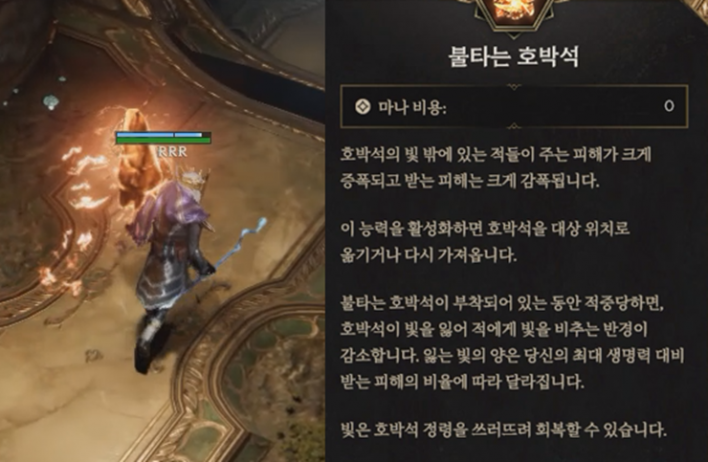
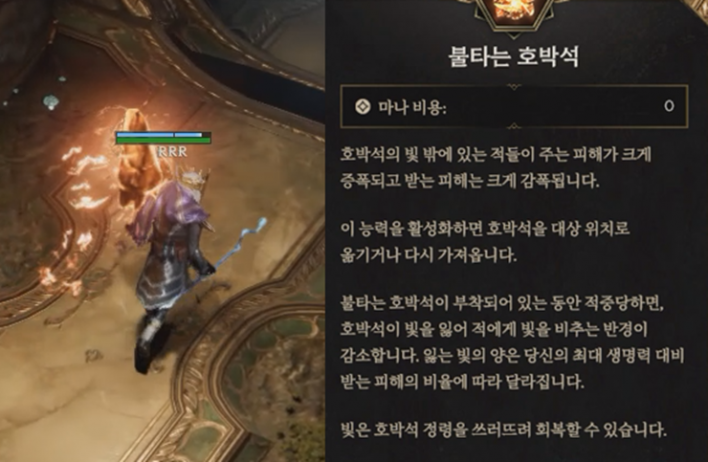
The Burning Amber and the light radius
On entry, the character carries the Burning Amber. The item creates a light radius that reduces damage dealt to enemies outside the lit area and increases damage taken from them. The detail that catches newcomers is the second half of the rule: every hit taken shrinks the light radius in proportion to the damage suffered relative to maximum health. Taking damage therefore costs more than health — it costs visibility, offensive reach and margin for error.
In practice, the dungeon rewards aggressive positioning and crowd control. Standing still trading blows in the dark is the fastest way to turn a smooth run into a death. Classes with good area clear and constant movement tend to suffer less than concentrated-damage builds with little mobility.
The Mountain Beneath: a boss that is invincible by design
The boss, The Mountain Beneath, cannot be defeated by direct damage. It is invincible while standing. The solution lies in the arena: players must destroy the root walls on both sides and ignite the fires near the kindling. Only when both fires are lit does the Mountain collapse, opening the way to attack the Stone Titan's Heart, the real target.
The fight is therefore a two-front execution test: survive the boss patterns while completing the environmental objective, without letting the Amber's radius collapse. It is one of the few encounters in the game where raw DPS solves nothing on its own.

Vaults of Uncertain Fate
Defeating the boss opens the Vaults of Uncertain Fate, a room where the player spends gold to receive items. Offers are presented randomly: accepting one adds extra chests, and it is possible to keep receiving new options even after accepting the first. Declining is also allowed, but it makes subsequent alternatives more expensive. The system works as a small resource-allocation mini-game, not an automatic chest.
“After defeating the boss, you reach the Vaults of Uncertain Fate, where you can acquire various items by spending gold. You choose whether to accept randomly presented choices to add extra chests inside the vault, or decline them and pick different options — but be aware that declining increases the cost.”
Soulfire Bastion: swapping shields and gambling cinders
The second dungeon sits in the Imperial Era, entered from Felled Wood. The minimum area level is 45 and the key starts dropping at level 47. Its mechanics are the simplest of the three, which makes Soulfire Bastion the natural choice for anyone learning dungeon rhythm before tackling Temporal Sanctum.
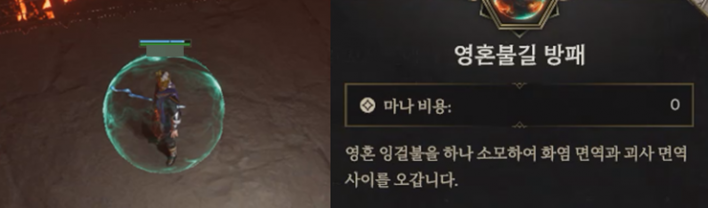
Soulfire Shield
Enemies dealing necrotic and fire damage appear continuously. The Soulfire Shield allows free switching between immunity to one type and the other. Each switch, however, consumes Soul Cinders, accumulated by killing enemies. The resource creates constant tension: every toggle is an economic decision, not a free button.
The classic mistake is toggling on reflex without reading which threat dominates the screen at that moment. Since the cost is paid on every switch, wasted toggles shrink the margin exactly when the boss demands more mobility.
Fire Lich Cremorus
The boss, Fire Lich Cremorus, has no particularly complex patterns. The difficulty comes from ground effects and from keeping the right shield active. Watching the floor before moving and switching only when the damage type changes solves most of the encounter. Builds with solid regeneration and balanced resistances turn the fight into an exercise in patience.
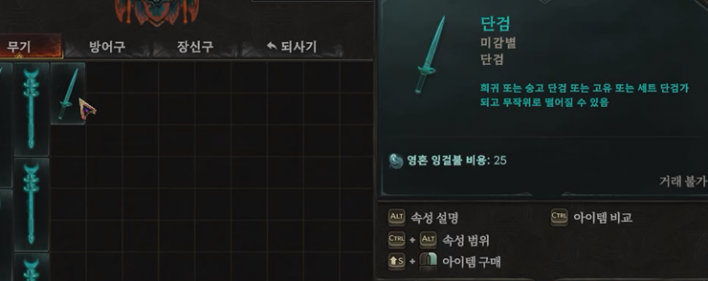
Soul Gambling
After the boss, accumulated Soul Cinders can be spent with a vendor in the Soul Gambling system. The player picks the slot to buy and receives a random item for that slot, with Rare, Exalted, Unique or Set rarity. It is an internal gacha, useful for filling specific gear gaps without relying exclusively on monolith farming.
Temporal Sanctum: the dungeon that crosses eras
The most advanced of the three sits on the border between the Imperial Era and the Ruined Era. The minimum area level is 55, with the key dropping from level 54. The initial route runs through Shining Cove in the Imperial Era to the ruined coastal region where the dungeon opens. From there, the player operates in two timelines at once.
Temporal Shift
On entry, the character gains the Temporal Shift ability, which allows free jumps between the Divine Era and the Ruined Era. The tool serves two purposes: bypassing paths blocked in one era and escaping attack patterns that exist only in the other. Many seemingly impassable passages are actually an invitation to switch dimensions.
It is the most versatile mechanic of the trio and the one that most changes how a map is read. Instead of memorizing routes, the player learns to identify where each era's geometry complements the other.
Chronomancer Julra
The boss, Chronomancer Julra, explores exactly the same logic: her patterns can be managed with era-shifting. Anyone trying to solve the encounter with damage alone tends to get stuck in areas where the only exit is a dimension swap at the right moment.
Eternity Cache and legendary items
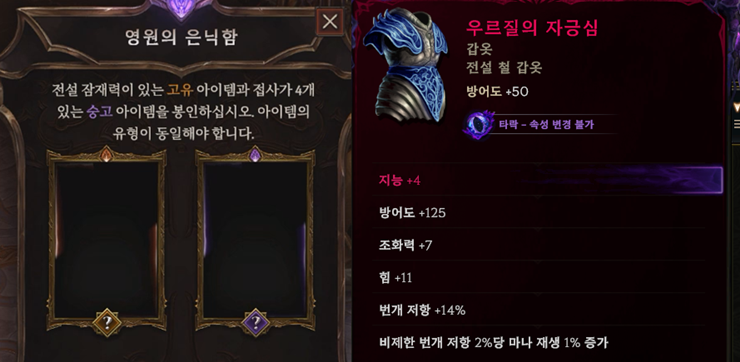
Clearing the dungeon grants access to the Eternity Cache in the Divine Era, where one of the game's most important interactions happens. The process combines a Unique item with Legendary Potential and an Exalted item with four unsealed affixes. A number of affixes from the Exalted item equal to the Legendary Potential is transferred at random to the Unique, creating a legendary item.
“Placing a Unique item with Legendary Potential alongside an Exalted item with four unsealed affixes transfers a random number of affixes from the Exalted item — equal to the Legendary Potential value — onto the Unique, forging a legendary.”
Comparison: eras, levels and rewards
| Dungeon | Era and access | Min. area level | Boss | Exclusive reward |
|---|---|---|---|---|
| Lightless Arbor | Ruined Era — Shrouded Ridge (via The Surface) | 22 | The Mountain Beneath | Vaults of Uncertain Fate (gold for items) |
| Soulfire Bastion | Imperial Era — Felled Wood | 45 | Fire Lich Cremorus | Soul Gambling (Soul Cinders) |
| Temporal Sanctum | Imperial → Ruined — Shining Cove / The Ruined Coast | 55 | Chronomancer Julra | Eternity Cache (legendary items) |
Keys: how to get them and when to spend them
Dungeon keys have no fixed market price and cannot be recovered after use. That means every attempt is an investment. The most reliable source is Monolith of Fate bosses, which guarantee the drop when defeated; rare monsters and regular bosses above the minimum area level have a lower chance of handing over the item.
Because the tier is set on entry, there is an obvious strategic decision: climbing tiers too early increases the risk of losing the key without finishing the run. The most efficient path is to settle into a comfortable tier, farm rewards until the build matures and only then move up. The same reasoning applies to the Eternity Cache — entering Temporal Sanctum without both required items (a Unique with Legendary Potential and an Exalted with four open affixes) wastes the game's most valuable run.
Three mistakes that cost the run
- Ignoring the dungeon ability. Amber, shield and temporal shift are not extras: they are the conditions for progress. Treating them as passive buffs is the most common cause of death in Lightless Arbor and Temporal Sanctum.
- Spending the key on a tier the build cannot sustain. High damage does not make up for missing resistances, health and recovery as the tier climbs. The key disappears, the loot does not come.
- Leaving the dungeon before using the reward. The Vaults demand gold, Soul Gambling demands Cinders and the Eternity Cache demands both prepared items. Reaching the end without the resources defeats the purpose of the visit.
What this changes in the endgame
The three dungeons form a closed economic circuit. Lightless Arbor turns gold into items, Soulfire Bastion turns effort into slot-targeted rolls and Temporal Sanctum turns two items into one legendary. None of them replaces the Monolith of Fate as the main farming source, but each solves a specific bottleneck the monolith cannot address with the same precision.
For newcomers, the natural order is Lightless Arbor, Soulfire Bastion and, last, Temporal Sanctum — exactly the sequence of mechanical complexity. For players with a stable build, the math changes: the Eternity Cache becomes the priority destination, because that is where the character takes the quality leap that separates a good set from a legendary one. More ARPG guides and analysis are available at /en/categoria/games/, and the official Last Epoch site can be found at lastepoch.com.
Suggested and related articles
Baldur's Gate 3: How to Save the Doomed Prisoners

Quarantine Zone: Complete Modern Prometheus Mission Guide

Climb For Animals Eggs: farm Speed fast in Roblox

Fisch guide: how to get the Omniscient Spinecaster rod

Jason in Fortnite Fortnitemares: Where to Find and How to Defeat the Camp Crystal Lake Terror